
Origin of hand cooked crisps
Written by Max Robertson
Hand cooked crisps are a more premium version of crisps. Or is it just a marketing facade?

What are hand cooked crisps?
In the realm of savoury snacks, hand-cooked crisps stand as a testament to the harmonious fusion of tradition, craftsmanship, and culinary innovation. Hand cooked crisps are a style of crisp usually thicker and with a satisfying crunch. They are a variation on the potato crisp, competing with many processes which take a different approach to the manufacture of crisps.
Normally they have a darker colour and are advertised as having more premium ingredients. It is not salt and vinegar it is sea salt and chardonnay vinegar. Instead of cheese and onion it is mature cheddar and red onion. These marketing tactics seep into the packaging of the crisps.
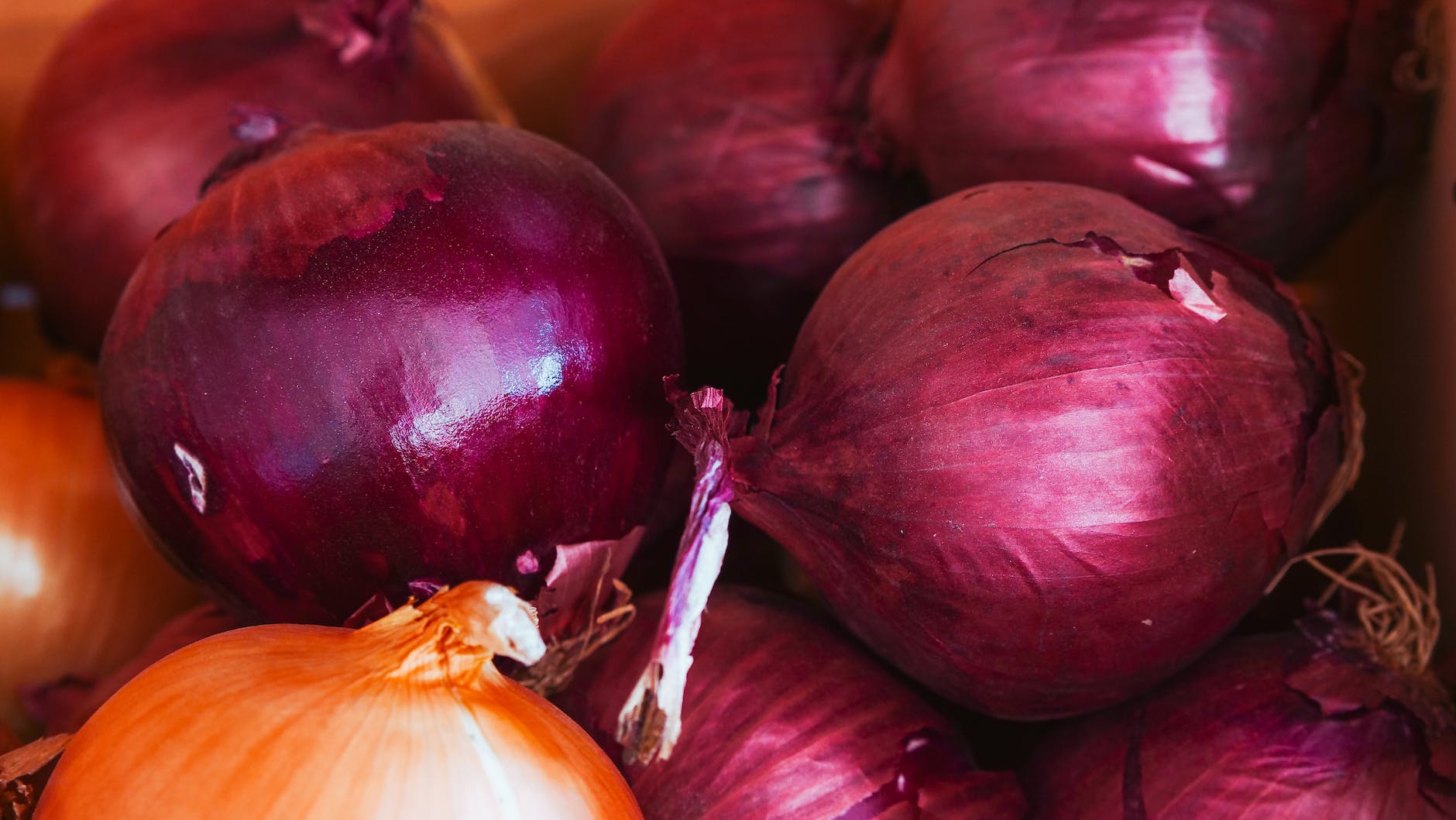
It is common to find pictures of the ingredients on the packaging, or pictures of people. This signifies to customers that the contents are both fresh and of premium quality, thereby justifying the higher price point. The inclusion of imagery depicting families or joyful moments serves the purpose of fostering the perception of a boutique enterprise, where meticulous attention and genuine passion converge to craft an exceptionally superior product that will be cherished by consumers. These tactics are so deeply ingrained within the hand-cooked crisps sector that they have become an integral facet for new entrants seeking to establish their presence. This marketing strategy has, in essence, chiselled out a distinctive niche within the competitive crisps market.
Whenever you go into a supermarket and head to the isle with savoury snacks, the hand cooked crisps are as distinguishable as Pringles, with their eye-catching cylindrical tube packaging.
When are hand cooked crisps?
Crisps and or chips (depending on where you come from) are first referred to in a recipe from 1817 in ‘The Cook’s Oracle’ by William Kitchiner. The recipe (number 104) is called “Potatoes fried in Slices or Shavings”, becoming the first ready salted crisps.
Potatoes were primarily consumed as a hearty and filling food, often boiled or mashed. However, it was in the 19th century that the concept of crisps – thin, fried slices of potatoes – began to take shape. There are legends suggesting that a chef named George Crum at Moon’s Lake House in Saratoga Springs, New York, unintentionally invented the potato chip in 1853. Crum supposedly sliced potatoes very thinly as a response to a customer’s complaint about the thickness of their fried potatoes, resulting in a crispy alternative that became an instant hit.
Crisps were first produced commercially by the Mikesell’s Potato Chip Company in 1910, America. These were unseasoned. The Smiths company, founded in London in 1920, spiced up the market by adding salt to their crisps. The crisp remained otherwise unflavoured until an innovation by Joe ‘Spud’ Murphy, owner of the Irish crisps company Tayto, who, in the 1950s, developed the technology to add seasoning during manufacture. A few years later in 1954, cheese and onion crisps were produced. Today there are more than 1,300 flavours and with a market worth an estimated $44 billion in 2023. Crisps are here to stay.

Why are hand cooked crisps?
Hand cooked crisps were brought to the main stage by Kettle chips. In 1978 Cameron Healy founded Kettle Foods in Salem, Oregan, USA. During a trip to Hawaii, Cameron tried a homemade potato crisp that changed his life. In the following years, he perfected the hand cooked crisp on a commercial scale. Using a rake method. But why are they so popular?
Hand cooked crisps have ‘chiselled out a distinctive niche within the competitive crisps market’ with massive help from their marketing. They are popular because they are good. They enhance some of the core concepts of a crisp such as stronger crunch, rougher texture, and thicker body. This creates a unique experience for the consumer, which has caught on, and is the favourite crisp eating experience of many.
How are hand cooked crisps?
The manufacturing process behind hand cooked crisps might come as a surprise. While they carry the “handmade” label, a significant portion of their production has been automated.
Let’s delve into the process from the outset. Specifically chosen potatoes are cultivated to transform into crisps. Typically, Russet or Maris Piper potatoes are favoured due to their high starch content, low moisture levels, excellent flavour absorption, uniform shape, and appealing colour.
Upon arrival at the factory, the potatoes undergo washing and subsequent peeling using a rough rotating drum. During the peeling stage, water is sprayed onto the potatoes. This abrasive peeling method minimizes potato wastage compared to blade-based peeling methods, a substantial food waste reduction on a commercial scale.
Following peeling, the potatoes are fed into a potato slicer, the settings of which vary according to the desired style (for hand cooked crisps, the slices are slightly thicker than the ‘Walkers’ style crisps).
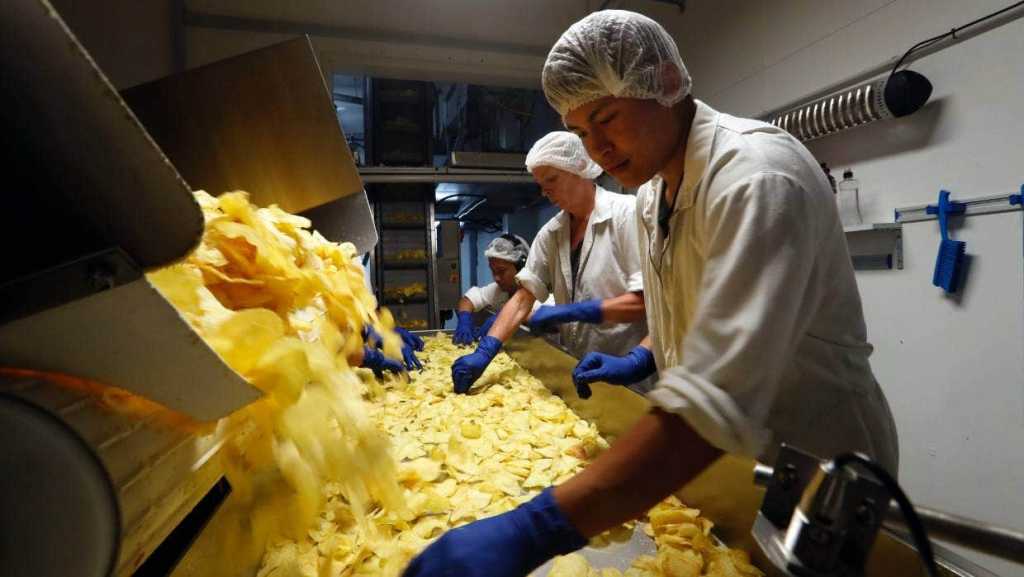
Once sliced, the potatoes proceed to the cooking phase. Initially, the traditional approach for hand cooked crisps involved batch-style cooking, where an employee would use a food-grade rake to prevent crisps from sticking together during the process. In a more contemporary method, the crisps move through an oil bath while still being raked, akin to a gentle river flow, ensuring uniform cooking.
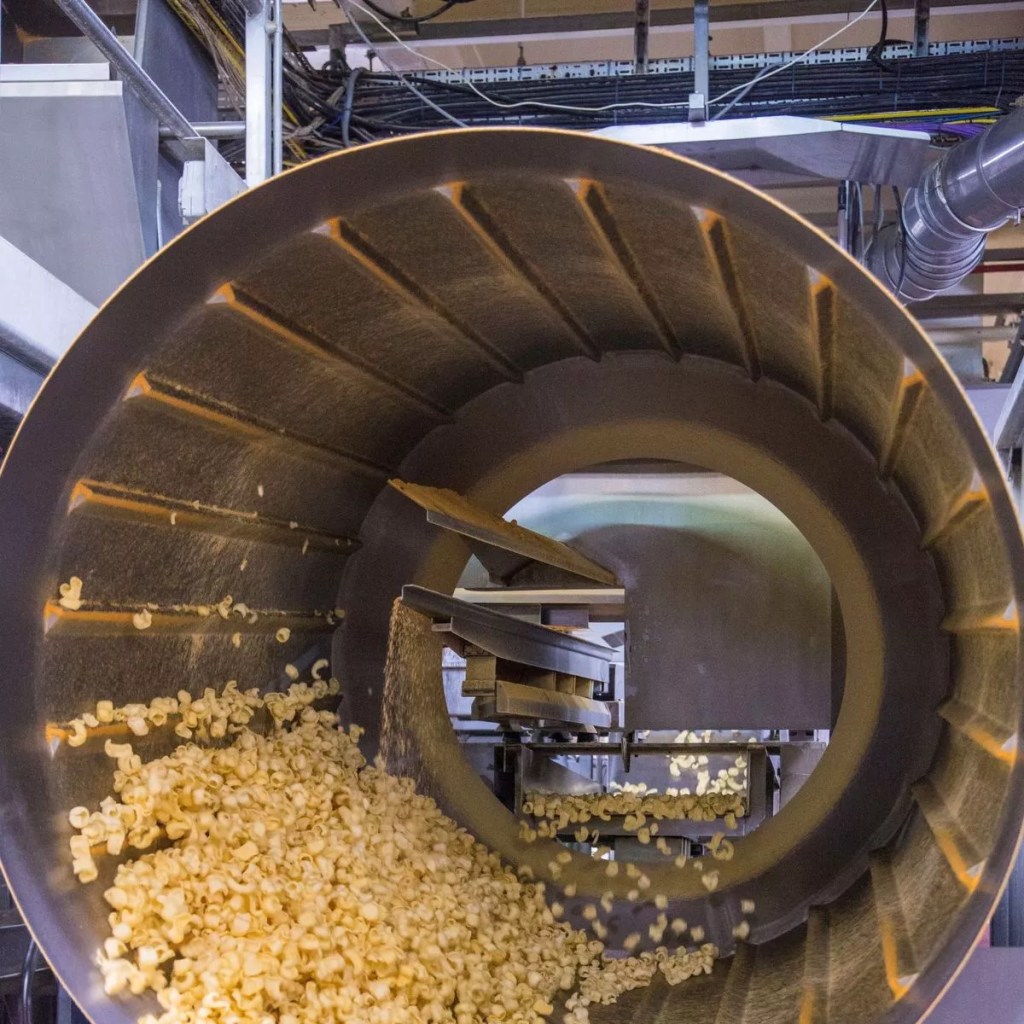
The final step encompasses seasoning the crisps. In this stage, the crisps enter a slow rotating drum, with seasoning being delicately sprinkled onto them. This meticulous process guarantees consistent seasoning distribution, ensuring that consumers enjoy a uniform flavor experience with each packet of crisps. Once the crisps are fully prepared, they undergo packaging and are subsequently dispatched for sale.
Conclusion
From its inception in an 1817 recipe, the crisp embarked on a transformative journey. While it initially lay dormant, the crisp gradually gained momentum, leading to its mass production during the early 1900s. Bolstered by shrewd marketing tactics and pioneering production techniques, it has now risen to the status of a ubiquitous commodity, cherished by a multitude. Nevertheless, the surge in factory output has introduced a paradox: the label “hand cooked” can be misleading, as only a fraction of the cooking process retains its manual touch. This evolution underscores how the landscape of snack production has been reshaped by technology and efficiency, blurring the boundaries between tradition and automation.

Thank you for reading please check out our other articles on EngBAM!
References
Photo by Dids on Pexels.com
Photo by Kindel Media on Pexels.com
 EngBAM
