
Do you know why D-Day is an important day for chemical engineers? This is the day where chemical innovation helped to save soldiers from infection and strengthen their bodies against harmful bacteria. Yes, this was the day that penicillin was mass distributed to the wounded soldiers coming to shore.
But accomplishing this was not easy.

This is an image of 3 soldiers carrying rucksacks on their backs and bayonets in their hands.
Today I will tell you a tale of risky business ventures, the hidden wonders of fermentation and thinking outside of the norm. These avenues allowed penicillin to be taken from its first glimpse in a Petri dish to industrial production in America. When biology and chemistry meets chemical engineering, unimaginable, yet undeniably wonderful things can happen.
In 1928, Alexander Fleming discovered something unusual in one of his Petri dishes. He was growing colonies of bacteria, yet in one Petri dish, all the bacteria had been engulfed. Killed. Gone. The strand that had killed the bacteria was penicillin (Science Museum, 2021). Although an extremely useful insight, Fleming had a challenging time convincing his colleagues about the wonders of this new discovery. He had an even tougher time attempting to purify penicillin; hence penicillin remained a ‘laboratory curiosity.’ Later, Howard Florey and a team of Oxford scientists proved the life-saving properties of penicillin, but because England had entered war in 1939, there was no money nor was there enough time to mass produce penicillin (Science Museum, 2021).
England desperately needed the medicine produced on a large scale, and fast, but did not have the funds for it. So, the British government contacted the American science community and gave them all their notes on penicillin (Science Museum, 2021). Since America was not at the centre of World War 2, but rather on the outskirts, the country was in a good economic position and was willing to help.
Now how does one go about scaling up penicillin?
There were 20 labs in America that were working hard to produce penicillin. A lab in Peoria, Illinois, found that upon adding corn-steep liquor to the mould broth, there was an exponential rise in penicillin growth (HistoryNet, 2014). Corn-steep liquor has three vital ingredients in high concentrations: those being sugar, amino acids and nitrogen. These three ingredients enabled the mould broth to produce a vast amount of penicillin.
| DID YOU KNOW? One day, a lab assistant from Peoria, named Mary Hunt, found a rotting cantaloupe. The cantaloupe produced six times more strains of penicillin than Fleming’s original one from 1928! (HistoryNet, 2014). |
What challenges would they encounter?
Chemical engineers who worked for Pfizer decided to use surface-level fermentation to produce penicillin, since the Pfizer company had been quite successful in using fermentation to obtain chemicals such as citric acid and gluconic acid (Development of Deep-tank Fermentation Pfizer Inc, 2008). However, the problems encountered were low yield of penicillin and risk of contamination.
So an engineer working for Pfizer, John McKeen and his chemist colleague Jasper Kane thought about how to improve the process. Kane suggested using deep tank fermentation. However, tanks were expensive. But Kane pushed the Pfizer company to choose the alternative method, even though they did not have the money to buy additional reactors (IChemE, 2010). Instead, they would use the fermentation vessels that were used to produce citric acid, to produce penicillin.
Pfizer made a risky business choice and bought a local ice factory from Marcy Avenue, Brooklyn. It was a risk because the company was earning a good amount of profit from making other chemicals, yet they chose to invest in penicillin, a tricky chemical to obtain. Nevertheless, the risk paid off. Pfizer took advantage of second-hand boilers and the inbuilt refrigeration units of the ice factory they bought (IChemE, 2010). Pfizer made their workers work 7 days a week, 16 hours a day to turn the ice factory into a penicillin factory (IChemE, 2010).
They finished the work in 4 months, beating the 6-month deadline by 2. Motivational posters were taped all over America’s labs, saying ‘Thanks to Penicillin, He Will Come Home!’ (‘He’ referring to the infected soldiers fighting at the warfront). This reminded the workers of their purpose and reignited their spirits.
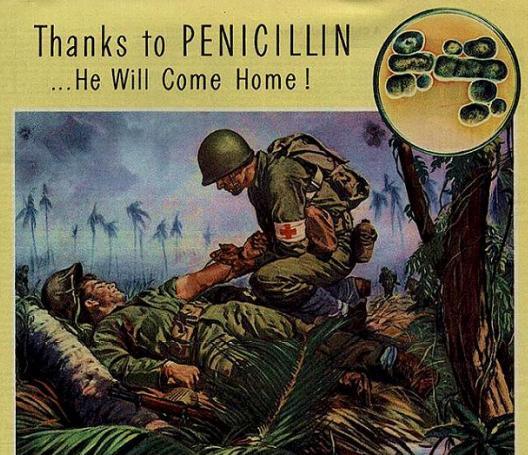
This is a poster that depicts a soldier kneeling over his comrade, holding his arm.
When Pfizer started making the broth needed to produce penicillin, the separation stage was the hardest. Penicillin was described as a ‘stingy’ magic drug (Development of Deep-tank Fermentation Pfizer Inc, 2008) solely because for every 10,000 parts of broth, you would only find 4 parts penicillin. When the penicillin was extracted, it had to be purified then poured into bottles that were thoroughly cleaned beforehand and kept in a sterile room to avoid contamination.
Pfizer’s risky business decision had turned out to be good, as they had produced 5 times the strain of penicillin with deep tank fermentation and went on to become the biggest name in the penicillin industry (IChemE, 2010). Furthermore, Pfizer was concerned about the purity of the penicillin. The company would ensure that the penicillin was crystal white before distributing it to the soldiers (Development of Deep-tank Fermentation Pfizer Inc., 2008).
Conclusion
We hope this article has inspired you to reflect on how chemical engineering can save lives, but it is not without its challenges. Scaling up is a complex process that requires a deep understanding of chemical reactions and methods to increase yield. Sometimes, it is good to take risks, just like Pfizer did, and to try a different method even when there are economic constraints. This is called ‘adapting’ and ‘experimenting’, two important habits of mind for an engineer.
References
Development of Deep-tank Fermentation Pfizer Inc. (2008). Available at: https://www.acs.org/content/dam/acsorg/education/whatischemistry/landmarks/penicillin/development-of-deep-tank-fermentation-commemorative-booklet.pdf.
HistoryNet. (2014). Here is Where: Penicillin Comes to Peoria. [online] Available at: https://www.historynet.com/here-is-where-penicillin-comes-to-peoria/ [Accessed 27 Jul. 2023].
IChemE (2010). Pfizer’s Penicillin Pioneers – Jasper Kane and John McKeen. [online] www.thechemicalengineer.com. Available at: https://www.thechemicalengineer.com/features/cewctw-pfizers-penicillin-pioneers-jasper-kane-and-john-mckeen. [Accessed 27 Jul. 2023]
Science Museum (2021). How was penicillin developed? [online] Science Museum. Available at: https://www.sciencemuseum.org.uk/objects-and-stories/how-was-penicillin-developed.
 EngBAM