
Do you think that chemical engineering is just about water flowing through a pipe? Think again.
This is an image of an opened bottle of pills.
This article aims to illustrate how the concepts of fluid flow and mass transfer have been combined by JustMilk, a non-profit organisation, to create a novel device that can enable breastfeeding mothers to feed their babies medicine.
In low-resource countries, like Kenya, it is a challenge to feed babies the correct dosage of medicine and nutrients (www.unicef.org, n.d.), due to factors such as a lack of proper equipment, lack of a hygienic and clean environment and because the mothers in poor countries have not been given sufficient education on infant health (JustMilk, n.d.).
As a result, in underdeveloped countries, there is a high infant death rate. For example, in 2019, five countries of sub-Saharan Africa had an under-5s mortality rate of more than 100 deaths per 1000 live births in 2019 (Sanyang, 2019). However, that same year, the under-5s mortality rate for Europe was 4 deaths per 1000 live births ((data.worldbank.org, n.d.). The death of infants in poor communities can be prevented by ensuring that babies receive the proper dose of medicine and nutrients (Outcomes et al., 2003).
This is where chemical engineers step in, to pioneer a solution.

This is a photograph of a Black mother feeding her baby milk via a bottle with her left hand, while carrying her baby in her right arm.
To address the problem, JustMilk created a thin silicone shield that the mother can place over her breast. On the tip of the silicone shield, is a tablet which rapidly disintegrates into the milk, while the baby is feeding on the mother. That way, the baby takes in the medicine without knowing, and since the medication is in the form of a pill, the mother does not have to worry about measuring the medicine out. Below is a diagram of the device as well as a picture showing how it works (JustMilk, n.d.).
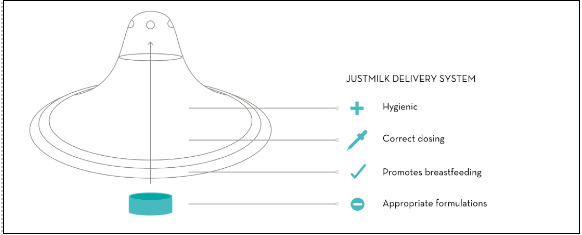
This is a black and white diagram of the silicone shield, shaped like a breast. Towards the bottom left, there is a turquoise disc shape which represents a therapeutic tablet/pill. The words on the right of the image are: ‘Hygienic’, ‘Correct dosing’, ‘Promotes breastfeeding’ and ‘Appropriate formulations’.
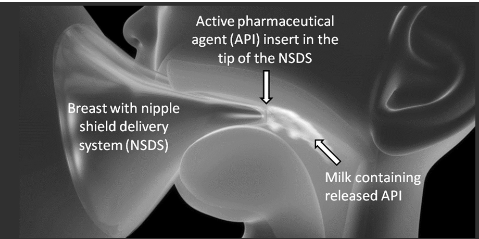
This is a diagram illustrating how the nipple shield delivery system (NSDS) works. It is a grayscale representation of a baby feeding off its mother’s breast. The darker and lighter shades of grey correspond to the different biological components of the baby and mother’s body: e.g. baby’s mouth and throat.
What has fluid flow and mass transfer got to do with this?
Good question. It turns out that these two concepts have a LOT to do with JustMilk’s engineering innovation. Let’s take a look at the grayscale diagram again.
As the infant suckles on the milk, the milk enters the silicone shield, and is in contact with the tablet. This causes the tablet to diffuse and release its API into the milk. The drug delivery system is controlled by diffusion, which is the process by which molecules move from an area of high concentration to low concentration (Siepmann and Siepmann, 2012). The scientific law related to diffusion is Fick’s law, which describes what happens when a solute travels from one area to another, separated by a thin membrane over the course of time. It is given by the following equation:
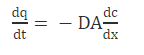
where:
q = quantity/amount of solute
A = the surface area of the membrane
c = concentration
D = diffusion coefficient
dx = membrane thickness
dc/dx = concentration gradient
The outer layer of the tablet gets dissolved first (Qureshi et al, 2021), and diffuses into the milk. Over time, the API particles inside the tablet get released into the milk as well, which is what will heal the baby’s illness/ provide the necessary nutrients.
Are we done with the science now?
Not yet. We still need to discuss the importance of fluid flow, more specifically, in relation to pressure.
Some studies argue that the vacuum pressure created in the baby’s mouth is what mainly influences milk flow, however, other scientists disagree (Geddes et al, 2012).
To investigate, Scheurle et al (2017) used an apparatus with a pump and a mechanical tongue that could copy the action of an infant feeding on a breast. They discovered that when the mechanical tongue rotated at a greater speed, the tablet dissolved at a faster rate into the milk. A faster rotational speed of the tongue corresponded with a higher suction pressure.
However, younger infants may not be able to exert a high suction pressure, therefore, Scheurle et al (2017) commented on how, by strategically placing the tablet on the tip of the silicone shield, it is easier for the baby to take in the medicine, since the posterior part of the tongue can apply a strong amount of pressure. This can ensure that the baby receives the correct dose of the API during use.
What has been the impact of this innovative device?
JustMilk, conducted studies in Kenya and found that community members had a positive response towards using the device to prevent mother-to-child transmission of HIV while breastfeeding (Hart et al, 2015). The community members of Kenya thought that the device was useful and practical.
However, mothers in Kenya expressed that they did not want this device to only be used for preventing HIV, as that would result in stigmatisation. Henceforth, Kenyan mothers recommend that the device is used also for other types of medical administration, so if a mother is using it to prevent HIV transmission to her baby, then other mothers won’t necessarily know if that is the case, they may think she is using the device for a different reason.
Conclusion
Often, we perceive engineering to be just numbers. We reduce the potency and power of this subject to an exhaustive list of equations and topics, like mass transfer and fluid flow, without really understanding why this matters, or how the concepts link.
When you make the connection between fluid flow and mass transfer, the way the engineers behind JustMilk, made the connection between milk flow and the mass transfer of a disintegrating pill, you can create a device that CHANGES LIVES.
We hope this article has inspired you to think deeply about the importance of making connections, and realising that engineering not only exists in big spaces like industrial plants but also in the smaller, more tender spaces, like the protective love a mother has for her baby. Chemical engineering provides a practical reinforcement of the mother’s intention to ensure her child survives.
References
data.worldbank.org. (n.d.). Mortality rate, under-5 (per 1,000 live births) – European Union | Data. [online] Available at: https://data.worldbank.org/indicator/SH.DYN.MORT?locations=EU.
Geddes, D. T., Sakalidis, V. S., Hepworth, A. R., McClellan, H. L., Kent, J. C., Lai, C. T., & Hartmann, P. E. (2012). Tongue movement and intra-oral vacuum of term infants during breastfeeding and feeding from an experimental teat that released milk under vacuum only. Early human development, 88(6), 443-449.
Hart, C. W., Israel-Ballard, K. A., Joanis, C. L., Baniecki, M. L., Thungu, F., Gerrard, S. E., … & Sokal, D. C. (2015). Acceptability of a nipple shield delivery system administering antiviral agents to prevent mother-to-child transmission of HIV through breastfeeding. Journal of Human Lactation, 31(1), 68-75.
JustMilk. (n.d.). What We Do. [online] Available at: http://www.justmilk.org/what-we-do [Accessed 24 Jul. 2023].
Outcomes, I. of M. (US) C. on I.B., Bale, J.R., Stoll, B.J. and Lucas, A.O. (2003). Reducing Neonatal Mortality and Morbidity. [online] http://www.ncbi.nlm.nih.gov. National Academies Press (US). Available at: https://www.ncbi.nlm.nih.gov/books/NBK222108/.
Sanyang, Y. (2019). Prevalence of under-five years of age mortality by infectious diseases in West African region. International Journal of Africa Nursing Sciences, 11, 100175.
Scheuerle, R. L., Kendall, R. A., Tuleu, C., Slater, N. K., & Gerrard, S. E. (2017). Mimicking the impact of infant tongue peristalsis on behavior of solid oral dosage forms administered during breastfeeding. Journal of Pharmaceutical Sciences, 106(1), 193-199.
Siepmann, J. and Siepmann, F. (2012). Modeling of diffusion controlled drug delivery. Journal of controlled release, 161(2), pp.351-362.
Qureshi, D., Nayak, A. K., Kim, D., Maji, S., Anis, A., Mohanty, B., & Pal, K. (2021). Polysaccharide-based polymeric gels as drug delivery vehicles. In Advances and Challenges in Pharmaceutical Technology (pp. 283-325). Academic Press.
http://www.unicef.org. (n.d.). Medicines. [online] Available at: https://www.unicef.org/supply/medicines.
 EngBAM